

Tag Archives: Academia




huronSYNERGY revisited
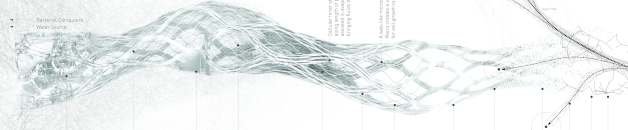
-New visualizations for Fall 2009 Huron River Watershed Council Headquarters. The model was parametrically built using Grasshopper following circulation curves in the landscape.
Thesis Update
-In thinking through the development of the project I am attempting to set up a narrative that ties into future aspirations of the city [Chicago], post-human futures, and biotechnical mergers. The project is attempting to achieve an architecture which would lay forth one possible scenario culminating from the merger of biology and technology where body/building […]
Scaffolding Proposal
Scaffolding: Site becomes a datascape as flows of information are processed within the existing context of proposed growth. Agent based simulations react to these flows of information, determining spatial organization and structural trajectories. These simulations become not acted out within a traditional computer and monitor, but projected into the atmosphere as the calculations are processed […]



Fourth Natures
‘In Garden Perfections: The Practice of Garden Theory (2000), the landscape theorist John Dixon Hunt elucidates three categories of landscape first defined during the Renaissance: ‘first nature’ being wilderness, ‘second nature’ being the cultivated landscape, and ‘third nature’ being the garden, a combination of nature and culture. One might argue that over the course of […]
Biophilia + Technophilia: Project Manual
-Click [the image above] to obtain your free digital copy of the Biophilia + Technophilia project manual. More to come on this project as the months rolls on. Click here to purchase.
biophilia + technophilia: thesis 2011
-January 07, beginning of digital mania thesis project; biophilia + technophilia. Opening Presentation Narrative: Biophilia + Technophilia (Slide 1) The project manual, entitled Biophilia + Technophilia attempts to decipher trends emerging within architectural design (since the early sixties[from Archigram to Buckminster Fuller to Phillip Beasley) to incorporate or draw upon a connection between human networks […]
- Digital Construction
- Tasting Space
- Inorganic Speciation
- Nervou[s]ystopia
- Beyond Pavilion Architecture
- Inorganic Speciation
- bus shelter concept iii
- branching morphogenesis
- HKS-dc Design Fellowship
- Self Replicating Nanobots
-
Amna saeed: hello! I'm an architecture student and working on a project about mycelium structures. I'm learning grasshopper but haven't gotten to…
-
Somewhat Paleo: Lovely blog you havve here
-
Edward C: This was a lovely blog posst
-
Shannon Burton: Grateful for shariing this
-
Prashant Gudsoorkar: Hi Jon, I hope this message finds you well. I am reaching out to inform you that we specialize in…
Subscribe
Connect with archimorph and help grow the network.


 archimorph